
Roddam Narasimha, space scientist, says that one of the most important assignments during this mission, which cost over Rs 300 crore, would be to tap and see how useful the helium found on the moon would be.
It is raining heavily at Sriharikota where the Satish Dhawan Space Centre is located
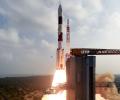
The Indian Space Research Organisation (ISRO) is all set to make its maiden commercial launch of 36 broadband communication satellites on board the space agency's heaviest rocket LVM3-M2, the countdown for which began early on Saturday at Sriharikota spaceport in Andhra Pradesh.
India becomes the fifth country after United States, Russia, China and France to enter the launch market.
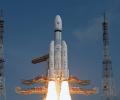
He said the test vehicle is ready at Sriharikota and the assembly work of the crew module and crew escape system has also begun.

In the first dedicated mission of its commercial arm New Space India Limited (NSIL), the Indian Space Research Organisation on Sunday successfully launched Brazil's earth observation satellite Amazonia-1 and 18 other co-passengers, including five built by students, onboard a Polar rocket from the spaceport in Sriharikota.

Days after Radhika Merchant and Anant Ambani's wedding, pictures of the celebrations continue to pour in.
Stage is set for the launch of PSLV-C9 from the Satish Dhawan Space Centre, Sriharikota. As many as ten satellites will be launched on Monday by the Indian Space Research Organisation, including country's latest remote sensing satellite and eight nano satellites.
Delhi will be the first place to be mapped by Cartosat followed by Goa.
"It will take about five-and-half days for Chandrayaan-1 to get to the moon," officials said, adding that the probe will be in a 100 km polar orbit around the Moon.
The ISRO will launch its ambitious and maiden mission to the moon, Chandrayaan-I, from the Satish Dhawan Space Centre at Sriharikota on April 9, 2008. "We are looking for a launch on April 9," Mylswamy Annadurai, head of Chandrayaan-I said.
Greet the scientists on achieving this major milestone!
The 44 metre tall four-stage PSLV placed Italian satellite AGILE into orbit at 550 km above the earth.
The PSLV-C8 rocket will make its first commercial launch with an Italian astronomical satellite on board.
India on Monday successfully launched Israeli satellite 'Polaris' from the Satish Dhawan Space Centre in Sriharikota by a homegrown Polar Satellite Launch Vehicle, a spokesman of the Indian Space Research Organisation said. This is the second time that a 'core alone' PSLV configuration had put a satellite into orbit. In April 2007, an Italian satellite Agile was put into the orbit, the space agency spokesman said.
ISRO's Polar Satellite Launch Vehicle-C6, carrying India's remote sensing satellite CARTOSAT-1 and a micro satellite HAMSAT, blasted off from the Satish Dhawan Space Centre in Sriharikota on Thursday.

The two satellites that PSLV will release in the orbit will help the country's mapmakers and amateur radio operators.
The launch vehicle that lifted off from a newly built launchpad will release two satellites in the earth's orbit.
It is scheduled for lift-off at 1658 IST on Thursday from the space port at Satish Dhawan Space Centre at Sriharikota, about 100 km from Chennai.
INSAT-4CR is similar to INSAT-4C, which was lost during the unsuccessful launch last year.

After the historic success of its Chandrayaan-3 lunar mission, Indian Space Research Organisation (ISRO) is going full throttle with its plans to send Indian astronauts for the first time to the Moon by 2040, ISRO Chairman S Somanath said.
The satellite was placed at 4.18 pm, a little over 17 minutes after the Geosynchronous Satellite Launch Vehicle (GSLV-F-01) carrying it was launched from the Satish Dhawan Space Centre in Sriharikota.
India will join an elite group of nations with the launch of a new mission to test re-entry technology, which would be a forerunner to developing reusable vehicles like space shuttles.
The 44.5-metre-tall, 295-tonne PSLV-C7 lifted off from the launch pad at 9.24 am.
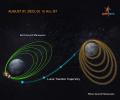
The Propulsion Module (PM) of Chandrayaan-3 has been moved from an orbit around the Moon to an orbit around Earth, the Indian Space Research Organisation (ISRO) has said, terming the operation a unique experiment.
The Polar Satellite Launch Vehicle is carrying 1360-kg satellite 'Resourcesat -I'.
This is the first time ISRO was putting into orbit a two-tonne class satellite.\n\n
The flight took off from Sriharikota in the Bay of Bengal on schedule.

"I am extremely happy to announce that GSLV Mark III successfully injected Chandrayaan 2 in the defined orbit, infact the orbit is 6,000 km more than what was intended," Sivan said.
The indigenous rocket will carry the second technology experiment satellite GSAT-2.
While the historic success of Chandrayaan-3 is celebrated by Indians across the world, two untrumpeted engineering colleges in Kerala are basking in the glory of the key role played by some of their alumni in the crucial Moon mission.

As more than 400 candidates from a single state -- Haryana -- had taken the test, there are suspicions over whether coaching centres may be involved.

While the mission is a follow-up to the PSLV-C55 TeLEOS-2 mission launched in April this year, scientists in Sunday's mission will place the fourth stage of the PSLV rocket in a lower orbit.

In a boost for the country's surveillance capabilities to monitor activities of both military warships and merchant shipping in the Indian Ocean Region (IOR), the 'Sindhu Netra' satellite developed by a team of young scientists from Defence Research and Development Organisation (DRDO) was successfully deployed in space on Sunday.
The party's economic wizard will be fielded from Andhra Pradesh.

The SSLV is designed to be affordable and amenable to industry production and aimed to function as a launch-on-demand platform for mini, micro or nano satellites.

The Trans-Lagrangian Point 1 Insertion manoeuvre marks the beginning of the spacecraft's about 110-day trajectory to the destination around the L1 Lagrange point, a balanced gravitational location between the Earth and the Sun.
